BCA 4th Semester Software Engineering Past Questions
Tribhuvan University · BCA Semester IV
BCA 4th Semester Software Engineering Past Questions
Tribhuvan University BCA Semester IV Software Engineering past questions from 2020, 2021 and 2023, covering software process models, requirements, testing, quality assurance, COCOMO, CASE tools, maintenance, reengineering and project management.
Exam pattern: Group B asks students to attempt any six questions for 30 marks, while Group C asks students to attempt any two questions for 20 marks. This page is formatted for easy reading on desktop and mobile and does not add a custom WordPress header or menu.
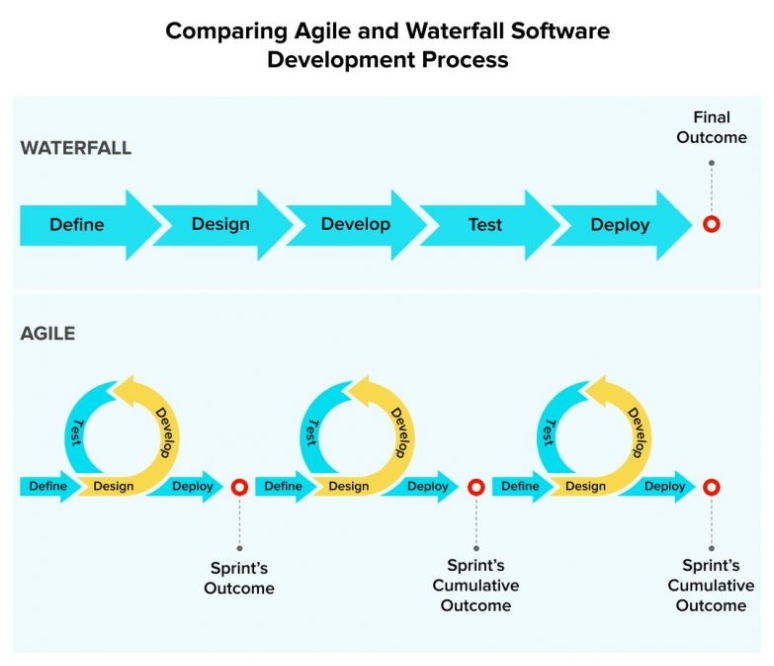
Waterfall and Agile development process comparison. Useful visual for software process model questions.Software testing and code review — relevant to verification, validation and software quality.
Software Engineering Past Questions 2020
CACS253 · Semester IV
60 Marks · Pass 24 · 3 Hours
Group B
Attempt any SIX · 6 × 5 = 30
2. What is software engineering? Explain the challenges facing software engineering. [2+3]
3. What is extreme programming? Explain how the principles underlying extreme programming lead to the accelerated development of software. [1+4]
4. Define quality assurance. Under what circumstances would you recommend the use of staged representation of the CMM? [2+3]
5. What is architectural design? Explain the layered model of software architecture with an example. [1+4]
6. Differentiate between verification and validation. Explain why software inspection is an effective technique for discovering errors in software. [3+2]
7. What is software reengineering? List its advantages. Explain source code translation and reverse engineering approaches in brief. [1+1+3]
8. What do you mean by software quality management? Explain software quality management activities in brief.
Group C
Attempt any TWO · 2 × 10 = 20
9. What is a software process model? List different software process models. Explain how both the waterfall model of the software process and prototyping model can be accommodated in the spiral process model. [2+2+6]
10. What do you mean by software requirement? Differentiate between functional and non-functional requirements. List the functional requirements of an online examination system and represent it in a use case diagram. [2+4+4]
11.
a. What is risk management? Explain the risk management process in software engineering with a block diagram. [1+4]
b. List good programming practices. Explain CASE and its types with examples. [2+2]
Software Engineering Past Questions 2021
CACS253 · Semester IV
60 Marks · Pass 24 · 3 Hours
Group B
Attempt any SIX · 6 × 5 = 30
2. What is a waterfall model? Describe the activities of the waterfall model and mention its drawbacks. [2+3]
3. What is CASE? Explain the importance of CASE tools in the software development life cycle. [2+3]
4. Define modularization. Differentiate between cohesion and coupling with a suitable example. [2+3]
5. What are programming languages? Explain various software development tools. [2+3]
6. Discuss the COCOMO model in software cost estimation in detail.
7. What do you mean by verification and validation? Differentiate between black-box testing and white-box testing. [2+3]
8. Explain activities in software quality assurance with an example.
Group C
Attempt any TWO · 2 × 10 = 20
9. Explain challenges faced by software engineering along with professional and ethical responsibility.
10. What is Capability Maturity Model? Explain its levels along with key process areas. Differentiate between alpha and beta testing. [2+4+4]
11. What do you mean by software maintenance? Explain the different types of maintenance. Explain the reengineering process in detail. [2+4+4]
Software Engineering Past Questions 2023
CACS253 · Semester IV · Batch 2020
60 Marks · Pass 24 · 3 Hours
Group B
Attempt any SIX · 6 × 5 = 30
2. What is software engineering? Explain the need for software life cycle models in software engineering. [2+3]
3. Why are programs developed using evolutionary development likely to be difficult to maintain? Explain.
4. What is meant by modular design? When and how should a modular design be implemented? [1+4]
5. Write a detailed note on coding standards.
6. Why is an SRS document also known as the black-box specification of the system? Explain with an example.
7. What do you mean by project management? Explain project planning and project scheduling with an example. [1+4]
8. Explain the COCOMO model for software cost estimation in detail.
Group C
Attempt any TWO · 2 × 10 = 20
9. What is Configuration Management? What are the five levels of CMM? List important features of these levels. [2+2+6]
10. Explain software requirement analysis and specification. Discuss various methods for requirement gathering. [4+6]
11. Write a detailed note on test case design techniques. Which method is best in integration testing, top-down or bottom-up? Support your answer. [5+5]